

The success of fertility treatment depends on a combination of multiple factors, ranging from age and hormonal balance to gamete quality and embryo development. The accuracy of diagnosis, chosen treatment methods, and the quality of laboratory work also play a crucial role, supported by international standards such as ISO 15189:2022. In addition, patients’ lifestyle, overall health, and previous treatment history influence treatment success. Therefore, every treatment journey is individual, and achieving the best possible outcome requires consideration of all these interrelated factors.
In 2025, a total of 212 in vitro fertilization procedures (IVF/ICSI) and 231 embryo transfers (ET/FET) were performed at Next Fertility Nordic clinic. The use of preimplantation genetic testing (PGT) increased significantly – it was applied in 48 patient treatment cycles, and a total of 182 embryos were analyzed.
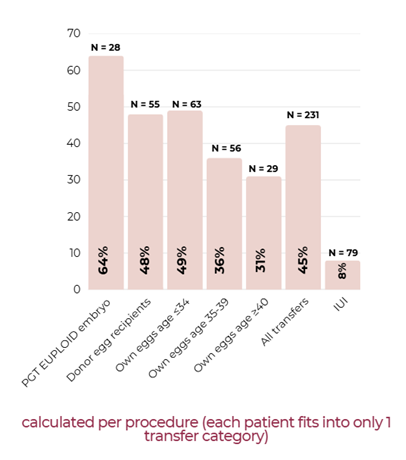
The highest pregnancy rate (67%) was achieved when transferring a euploid embryo (with a normal number of chromosomes) selected through PGT. The clinical pregnancy rate with donor oocytes was 48%. The success rates of procedures using patients’ own oocytes depended primarily on the woman’s age: 49% for women equal or under under 34, 36% for those aged 35–39, and 31% for women equal or over 40.
We are pleased to note that the fertility treatment outcomes at Next Fertility Nordic clinic improved further in 2025. While in 2024 clinical pregnancy was achieved in 40% of embryo transfers (n=262), in 2025 this increased to 45% (n=231), resulting in a total of 105 clinical pregnancies. The slight decrease in the number of procedures was mainly due to a reduced need for repeated treatment cycles, indicating improved treatment efficiency.